
The Kalapani–Limpiyadhura Dispute: An Urgent Call for Clarity
 गोविन्द शर्मा पोखरेल

Introduction
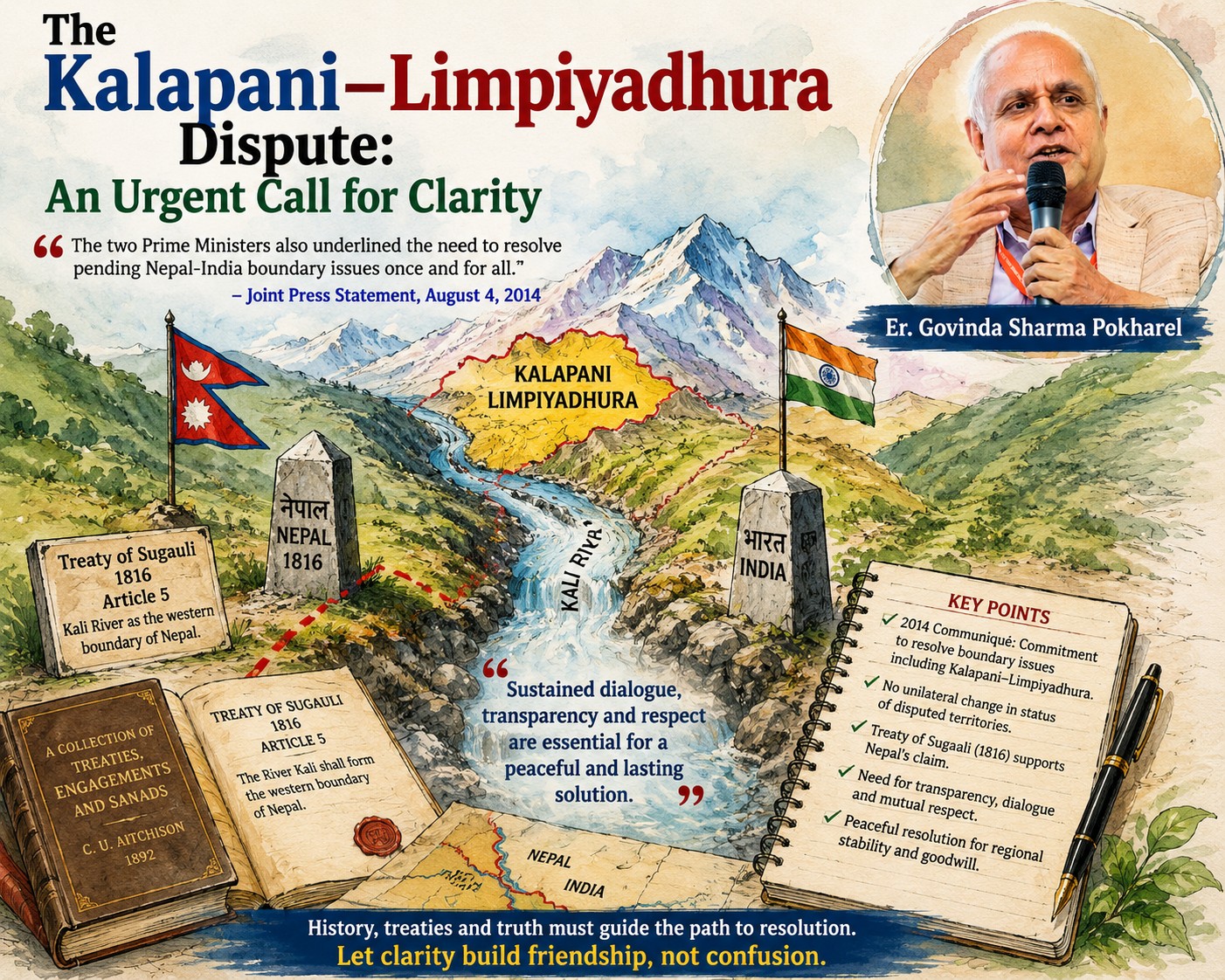
Quoting Article 12 of the Joint Press Statement on the Visit of the Indian Prime Minister to Nepal published by the Ministry of External Affairs, India: Media Center on August 04, 2014 “The two Prime Ministers also underlined the need to resolve pending Nepal-India boundary issues once and for all. They welcomed the formation of the Boundary Working Group (BWG) to undertake the construction, restoration and repair of boundary pillars including clearance of 'Noman's land' and other technical tasks. They also welcomed the Joint Commission's decision to direct the Foreign Secretaries to work on the outstanding boundary issues, including Kalapani and Susta receiving required technical inputs from the BWG as necessary. The Indian side stressed on early signing of the agreed and initialed strip maps of about 98% of the boundary. The Nepalese side expressed its desire to resolve all outstanding boundary issues” unquote.
The first highlighted part of the statement refers to resolving all pending boundary issues along Nepal India Border. This means that the prime ministers of the two countries recognize that there are border disputes between Nepal and India and that they need to be resolved once and for all. There is no timetable mentioned in the communique however the last section of the paragraph is clear about it. The second highlighted text refers particularly to outstanding boundary issues at Kalapani and Susta. The pending boundary issue of Kalapani is the issue of Kalapani-Limpiyadhura area which has been disputed by India since about 1960. This is the area that was unilaterally included by India in their latest political map published in 2019. And this is the area included by the Nepalese parliament into the political map of Nepal in 2020 about six months after its cartographical Indian annexation.
The Kalapani–Limpiyadhura boundary dispute between Nepal and India has long been a sensitive issue, deeply rooted in the treaties, their interpretations and the experiences of the communities residing in the so called “disputed” areas of Nepal. The border controversy intensified after India’s unilateral cartographic annexation of the Kalapani–Limpiyadhura area in 2019, despite earlier commitments by both governments to resolve this dispute through secretary level dialogue in 2014.
The 2014 Communiqué and Its Significance
In August 2014, the prime ministers of Nepal and India signed a communiqué acknowledging unresolved boundary issues. Importantly, the communiqué directed the foreign secretaries of both countries to resolve the dispute on Kalapani–Limpiyadhura through dialogue. This was a formal recognition that certain areas, including Kalapani–Limpiyadhura, were contested and therefore required an urgent settlement through dialogue.
The communiqué represented a diplomatic understanding: neither side would unilaterally alter the status of disputed territories until a mutually agreed resolution was reached. Yet, India’s subsequent cartographic annexation contradicted this spirit. By officially depicting Kalapani–Limpiyadhura as part of India, New Delhi signaled a unilateral claim, raising the question: how did a territory acknowledged as disputed in 2014 suddenly become “part of India” by 2019? An urgent explanation is sought!!
Between 2014 and 2019: What Changed?
The years between 2014 and 2019 were marked by significant geopolitical shifts. India, under Prime Minister Narendra Modi, pursued a more assertive foreign policy, emphasizing national security and territorial integrity. Meanwhile, Nepal underwent political transformations, based on its new constitution promulgated in 2915.
However, there was no war, no formal negotiation, and no documented agreement granting India sovereignty over Kalapani–Limpiyadhura. The foreign secretaries, tasked with resolving boundary disputes, did not announce any settlement or agreement between them. Thus, the Indian annexation lacks a legally binding basis. If India claims otherwise, it must present evidence of a legitimate agreement or negotiation leading to border settlement. Without such documentary evidence, the annexation has been perceived by Nepal as unilateral, unjustified and against the UN Charter. This is against the principal of good neighborly coexistence.
Legal Foundations: The Treaty of Sugauli
Nepal’s position rests firmly on the Treaty of Sugauli, signed in 1816 between Nepal and the British East India Company. Article 5 of the treaty clearly delineates boundaries, placing the western bank of the Kali River as the western border of Nepal and India with the whole of the Mahakai or Kali River within the territory of Nepal. The political maps published and valid at the time the treaty was signed between the Parties include Kalapani–Limpiyadhura within Nepalese Territory. No other treaty concerning this stretch of boundary between Nepal and the British India or India post 1947 formation of India as an independent nation has been agreed and signed between the two neighbors.
The treaty’s authenticity is beyond dispute. It was published by the Government of British India in official collections, such as C. U. Aitchison’s A Collection of Treaties, Engagements and Sanads (1892). This reference remains authoritative, underscoring Nepal’s claim. Unless India can produce more valid references superseding the treaty, India’s position remains legally baseless and therefore India’s claim can only be understood as Indian’s expansionist policy encroaching into lands of smaller and weaker ‘friendly’ neighbor.
Further strengthening Nepal’s position are the memorandum of December 6, 1816 and the decision of the Government of British India of November 1, 1860, when the Government of British India restored certain Tarai lands to Nepal. This restoration reaffirmed Nepal’s sovereignty over territories previously ceded under the Treaty of Sugauli. Nepal’s interpretation of its boundary is therefore consistent not only with the original treaty but also with subsequent official decisions. India’s position, by contrast, appears inconsistent. New Delhi should legally acknowledge the legitimacy of British-era treaties and decisions if such treaties and decisions are not revised by treaties or decisions mutually agreeable to both the Nations. Therefore, India’s claim on Kalapani–Limpiyadhura area is unfounded and baseless. But if India choses to ignore the treaty signed by British India, Nepal’s claim for ‘Greater Nepal’ gains strength as Nepal lost most of its territories to British India through the Treaty of Sugauli, particularly the Article 5 of the Treaty. Such a situation in the neighborhood requires a third neutral party and the UK as the signatory of the Treaty of Sugauli qualifies as the third Party.
The Unilateral Cartographic Annexation of 2019
In 2019, India released a new political map depicting Kalapani–Limpiyadhura as part of India. For Nepal, this is a clear violation of the 2014 communiqué and of historical treaties by India and therefore is not acceptable to Nepal.
The annexation sparked widespread protests in Nepal. Political leaders, civil society, and ordinary citizens condemned India’s action, viewing it as an encroachment on Nepalese sovereignty. The Government of Nepal responded by publishing its own official map in 2020, which included Kalapani–Limpiyadhura within Nepal. This cartographic confrontation symbolized the deepening mistrust caused by Indian expansionist policy.
The Role of Intellectuals and Analysts
Former R&AW senior official R.K. Yadav and Nepalese historian Purushottam Shamshere JBR have argued that India harbors intentions to annex at least parts of Nepal. Their writings, combined with India’s push to finalize strip maps excluding disputed areas, reinforce suspicions of deliberate encroachment into Nepalese territories.
The Need for Transparency and Accountability
Given these developments, India owes both Nepal and its own citizens a clear explanation. Did the foreign secretaries agree to annexation? If so, did they possess the legal authority to make such a decision? If not, on what basis does India claim sovereignty over Kalapani-Limpiyadhura area?
Without satisfactory justification, India risks being seen as violating international norms. An official apology would go a long way in restoring trust. Apologies are not signs of weakness but of maturity and respect. By acknowledging mistakes, India could reaffirm its commitment to friendship and cooperation with Nepal.
Broader Implications for Bilateral Relations
The Kalapani–Limpiyadhura dispute is not merely about a few square kilometers of land. It symbolizes the broader dynamics of Nepal–India relations. For Nepal, sovereignty and dignity are non-negotiable. For India, regional stability and goodwill should have been their strategic assets. A prolonged dispute undermines both. It risks fueling anti-India sentiment in Nepal and weakening India’s influence in South Asia.
Conclusion
The Kalapani–Limpiyadhura dispute is a test of India’s commitment to fairness and Nepal’s determination to safeguard sovereignty. The 2014 communiqué promised resolution through dialogue, yet unilateral annexation in 2019 betrayed that promise. Historical treaties, political maps valid at the time of the Treaty and intellectual critiques all confurm to the legitimacy of Nepal’s claim. India must therefore provide a transparent justification or issue an apology. Only then can the two nations move forward as true partners, respecting each other’s sovereignty while nurturing the bonds of friendship that have long defined their relationship.
The peoples of Nepal and India deserve clarity, justice, and peace. Anything less risks perpetuating mistrust and undermining the very foundation of their shared future
In this context, Nepal should try to involve the UK as the third party as the one who was indeed the Party with which the initial border agreement was signed by Nepal. Therefore, the UK should at least provide authenticity certification to the documents produced by the two countries as most of the documents with the Nepalese side are from the period of the British rule in India and Nepal doubts if India has anything credible to support their case.
लेखकको बारेमा

प्रतिक्रिया
भर्खरै
-
एनएमबी बैंक र र्यापिड टेकबीच डिजिटल बैंकिङ सेवा विस्तार गर्न साझेदारी
-
सम्पर्कविहीन प्राधिकरणका ६ कर्मचारीका परिवारले पाए राहत
-
सङ्खुवासभाको विकट हटियामा पुग्यो राष्ट्रिय प्रसारण लाइनको विद्युत्
-
सुनकोशी-मरिनको बाँकी संरचना निर्माणका लागि तीन कम्पनीको प्राविधिक प्रस्ताव ग्राह्य
-
विद्युत् व्यापारको अनुमतिपत्र माग्दै ग्रिड ट्रेड इनर्जी मन्त्रालयमा
-
मौसम चेतावनीमुक्त सोमबार, पहाडी र हिमाली क्षेत्रमा वर्षा–हिमपातको सम्भावना